
Blogs
7 Benefits Of Starter vs Alternator Systems

Oct
You climb in, press the button, and the engine is running before you’ve even buckled up. Most of us never give it a thought, until one cold morning the car does nothing but click. Behind that everyday moment, three parts pass the baton: the battery, the Starter vs. Alternator and the alternator.
Understanding the differences between the Starter vs. Alternator can save you time and money when diagnosing car issues.
The relationship between the Starter vs. Alternator is crucial for the vehicle’s functioning.
Once you know what each one really does, it’s easier to work out which one is misbehaving, and you’re less likely to pay for a part you didn’t need. Here’s how they cooperate, how they differ, what failure looks and sounds like, and what to think about before you order a replacement.
Table of Contents
Meet the Team: Battery, Starter and Alternator
- Battery: the energy store. It feeds the starter, and it keeps accessories alive while the engine is off.
- Starter motor: a strong little electric motor with one task, spinning the engine until it fires on its own.
- Alternator: a generator turned by the engine’s belt. Once the engine runs, it carries the electrical load and refills the battery.
A simple way to remember it: the battery kicks things off, the starter gets the engine turning, and the alternator takes over from there.
What the Starter Motor Does
To appreciate how vital each part is, let’s delve deeper into the Starter vs. Alternator mechanics.
In the comparison of Starter vs. Alternator, the distinction in their functions becomes clear.
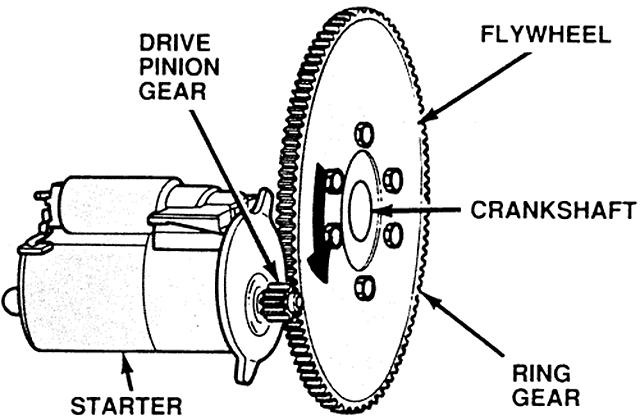
When you turn the key or press the start button, a small signal reaches the starter’s solenoid. The solenoid does two jobs at once. It pushes a small gear (the pinion) forward until it locks into the big ring gear on the flywheel or flexplate, and it closes heavy contacts so the battery’s full current can reach the motor. The motor then spins the engine until combustion takes over.
The role of the Starter in the Starter vs. Alternator dynamic is foundational for starting your engine.
The Parts Worth Knowing:
- Solenoid: the switch and the pusher in one.
- Pinion gear: the link between the starter and the engine.
- One-way clutch: once the engine fires, it spins far faster than the starter could ever turn. This clutch lets the pinion freewheel so the starter isn’t flung apart.
- Motor windings, brushes and housing: these produce the twisting force.
Starters are built for short bursts. If the engine doesn’t catch within a few seconds, give it a moment before the next try. Holding the key down for long stretches overheats the motor and drains the battery.
What the Alternator Does
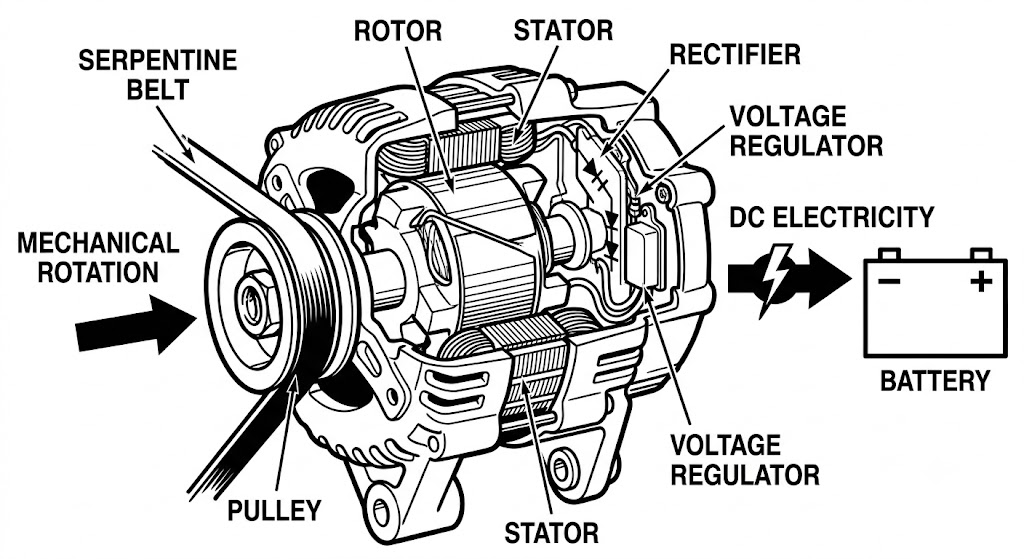
As soon as the engine runs, it spins the alternator pulley through the serpentine belt, and the alternator converts that motion into electricity. Inside you’ll find:
- Rotor: a spinning electromagnet.
- Stator: fixed coils where alternating current (AC) is generated.
- Rectifier: a set of diodes that changes AC into direct current (DC), the kind your battery and electronics use.
- Voltage regulator: watches the system voltage and turns the rotor’s magnetic field up or down, so output stays steady whether you’re idling with the defroster on or cruising with everything off.
With the engine running, a healthy system usually reads around 13.7 to 14.7 volts at the battery. Targets vary by vehicle, and some newer cars adjust charging voltage on purpose, so check your owner’s manual if a reading surprises you.
When one system fails, the other may also be affected, highlighting the Starter vs. Alternator connection.
Understanding how the Starter vs. Alternator operate together can clarify many car starting issues.
In many vehicles, the Starter vs. Alternator work in tandem to ensure smooth operation.
How the Three Work Together
- You start the car. The battery sends power to the starter circuit.
- The starter cranks. The pinion engages and the heavy contacts close. Cranking pulls a huge surge of current, much more than any other part of the car, so battery voltage dips for a moment. That’s normal.
- The engine catches. The one-way clutch releases the starter, and the solenoid lets go when you let off the key or button.
- The alternator steps in. As engine speed climbs, it supplies the ignition, lights, infotainment and everything else.
- The battery recovers. Whatever the car isn’t using flows back into the battery.
There’s one important limit. An alternator is meant to top up a battery that’s already mostly charged, not to bring a flat one back to life. Short drives or idling after a jump-start rarely finish the job, and forcing an alternator to chase a drained battery keeps it working flat out for a long time. If your battery has gone flat, recharge it with a proper battery charger.
Starter vs. Alternator: What Sets Them Apart
Starter motor
- Main job: turns the engine over until it starts.
- Power source: the battery.
- When it works: only for a few seconds at startup.
- Typical failure signs: a click with no crank, grinding, or a whirring sound.
Alternator
- Main job: powers the electronics and recharges the battery.
- Power source: the engine, through the belt.
- When it works: the whole time the engine is running.
- Typical failure signs: a warning light, dim headlights, or a battery that keeps going flat.
Warning Signs: Starter, Alternator or Battery?
The symptoms overlap a lot, which is why it pays to check before you buy.
Starter symptoms
- A single click, or complete silence, with no cranking
- A whirring sound where the motor spins but the engine doesn’t, often a worn clutch or damaged ring gear
- Grinding at startup, which suggests the gears aren’t meshing cleanly
- Smoke or a burning smell after repeated attempts
The transition from the Starter to the Alternator is a crucial aspect of automotive engineering.
Fast, repeated clicking is more often a weak battery or a loose cable than a bad starter.
Alternator symptoms
- A battery or charging light that comes on while you’re driving (it points to the charging system, not just the battery)
- Headlights that dim or flicker, especially at idle
- A whine or growl from worn bearings, or a squealing belt
- A battery that keeps dying even after a jump-start
- Stalling or strange electrical behaviour
Battery Symptoms
- Slow, lazy cranking, especially on cold mornings
- Age: most batteries last roughly three to five years, and even a new one can lose around a third of its capacity in deep cold.
Quick Troubleshooting Before You Buy
Keep hands, hair and tools away from belts and fans, and take off any jewellery near the battery.
- Look first. Check for corroded or loose terminals, damaged cables, and a cracked or slipping belt. A loose or broken belt means no charging at all.
- Measure the resting voltage. With the engine off, a multimeter should show about 12.6 volts on a fully charged battery. A clearly lower number means it’s partly drained.
- Measure it running. With the engine on, you want to see roughly 13.7 to 14.7 volts. If it stays near or below 13, the charging side needs attention.
- Add some load. Turn on the headlights, blower and rear defroster, then check again. The voltage should hold steady.
- Listen to the crank. A slow crank with good charging points to the battery or the starter. A strong crank that never fires usually means a fuel or ignition issue, not the starter.
- Get a proper test if you’re unsure. Many shops will check the battery and charging system for you.
It’s important to know the main role of each part when considering the Starter vs. Alternator.
Replacing a Starter or Alternator: What to Consider
- Check the battery first. A tired battery can imitate both failures. Charge and test it before blaming anything else, because a new alternator shouldn’t be asked to revive a flat battery.
- Match the part exactly. Go by year, make, model and engine. Compare mounting points, electrical connectors, pulley type and output rating (alternator), or gear and solenoid style (starter) with your old part before installing.
- Inspect the neighbours. On an alternator job, look at the belt and tensioner. On a starter job, check the ring gear teeth. On either one, look over the battery cables and ground connections.
- Don’t replace both by default. Swap what has actually failed, unless both are showing symptoms or you’re already deep into the job. Alternators commonly last somewhere around 130,000 to 240,000 km, but treat that as a rough guide. Starter life depends more on how many times it has been used than on distance alone.
- Plan for Canadian winters. Cold slows the battery’s chemistry and thickens engine oil, so both parts work harder. Deal with slow cranking early. If your vehicle has stop-start, replace the battery with the same type it came with.
- Read the warranty and return terms before you order.
Frequently Asked Questions
What’s the difference between a starter and an alternator?
The starter borrows battery power to crank the engine for a few seconds. The alternator uses engine power to run the electrical system and recharge the battery while you drive.
In the context of car maintenance, Starter vs. Alternator issues can emerge in various ways.
Can a bad alternator stop my car from starting?
Indirectly, yes. If it isn’t charging, the battery slowly runs down until it can’t turn the starter. A car already running with a failing alternator will keep going only until the battery is empty.
How do I tell if it’s the battery, starter or alternator?
Start with battery voltage. A low resting reading points to the battery or charging. A healthy battery with just a click points to the starter circuit. A running voltage near or below 13 points to charging.
Why does my car click but not start?
Rapid clicking usually means the solenoid isn’t getting enough current, most often from a weak battery or a poor connection. A single click with a healthy battery can mean a worn solenoid or starter.
Can you jump-start a car with a bad alternator?
Often, yes. But nothing refills the battery afterwards, so the car may stall soon after. Treat it as a short trip to a safe place or a repair shop.
Will driving charge a dead battery?
Partly, but alternators are designed to maintain a charged battery, not revive a deeply drained one. A proper battery charger is the safer choice.
How long do starters and alternators last?
There’s no fixed number. Alternators are commonly quoted at about 6 to 10 years. Starter life depends heavily on the number of starts, battery health and how many short trips you make, so mileage alone is a poor guide.
Can a bad alternator damage a new battery?
Yes. A weak alternator can leave a battery undercharged, and a failing regulator can overcharge it. Test the charging system when you fit a new battery.
Can I drive with the battery warning light on?
Only briefly. The car is running on stored battery power. Switch off anything non-essential and head for a safe place or a repair shop.
Keep Your Drive Starting Strong
The battery, starter and alternator each do one job, and each depends on the others. Diagnose first, then replace only what has actually failed.
When you’re ready, browse Denparts’ range of replacement starters and replacement alternators for cars and trucks, and keep your vehicle details handy to find the right fit. For more background, read our guides on choosing the right starter motor in Canada and alternator parts and their functions. Take a look at the Returns & Warranty page before you order.
Related Posts

